
Why The Origin of Chronic Fascial Pain Is So Hard to Find
Chronic (fascia) pain can have many causes, and treatments seem to be endless. “When will it stop?” Most people struggle to identify the true origin of their pain, and the modalities they turn to treat symptoms rather than systems, postural patterns.
These symptomatic modalities are not designed to address this type of pain, because chronic pain generally arises from long-held movement and postural patterns.
So what holds these patterns structurally?
Fascia. The connective tissue that solidifies neruological movement habits into subconscious movement patterns.
What is Fascia?
Fascia at its core is connective tissue. As the name suggests, connective tissue connects the body’s perceived individual segments into one congruent whole. And there are many more elements to fascia, with its connectivity and how it drives biomechanical auto regulation of every other system in the body, however that is a deeper discussion for another time.
A great example of fascia’s role in supporting and connecting the whole human body is myofascia. So what is myofascia?
Well, myofascia has fascia that surrounds a whole muscle, then bundles it into smaller fascial segments, and finally wraps the individual muscle fibers themselves. These fascial layers provide support and direction to the muscle fibers by running continuously into the tendons of the muscle. Those tendons then connect to the periosteum, the surface of the bones, which in turn runs continuously into other fascia and myofascia segments.
In other words, fascia provides a continuous fibrous net throughout the entire body, guiding force and structure from bone to bone.
The distinction of tendon, periosteum, and the layers around the muscles are there solely to help us understand the functions of the body from a reductionist viewpoint. Generally, a reductionist view is great for developing a deeper understanding of individual parts, however, these individual parts are not in fact individual. In any person these parts are continuously connected, and have even developed from the same tissue type during embryological development, formation of another human.
“Understanding this continuous fibrous net is the first step toward understanding how chronic fascia pain develops in the first place.”
How Does Fascia Contribute to Chronic Pain?
First off, Fascia contains the greatest concentration of sensory nerves and free nerve endings in the body, constantly sending information to the brain and surrounding tissues. And because fascia permeates and connects the whole body into one fibrous net, these nerve endings respond directly to the balance of tension across that entire system.
An unbalanced body develops through repeated maladaptive movement or unresolved emotional energy, trauma. Over time, these patterns solidify into stuck postural patterns that shape how you stand, move, and feel.
When those stuck patterns become more extreme or prolonged, the nerves in fascial tissue either suppress that pain from conscious perception or amplify it into chronic pain.
For many people, chronic fascial pain begins not with a single injury, but with years of subtle, accumulated tension the body can no longer ignore. Finally, an origin for chronic pain.
Why Does Stretching and Massage Alone Fall Short?
“Many people experiencing chronic fascia pain turn to stretching or massage hoping for relief: ‘I do yoga twice a week and get a massage once a month. Why am I not fixed?'”
The reason stretching fails to resolve chronic myofascial pain is multidimensional:
- Your yoga practice or stretching practice is not done long or often enough.
- The intensity, the beneficial discomfort, of your stretching practice hasn’t reached the level it needs to.
- Your stretching practice lacks the specificity needed to unravel stuck postural patterns.
- Your stretching practice does not integrate or alter movement patterns within gravity
The first two dimensions of a yoga “asana” practice are necessary for a base level of change, and most people rarely reach the frequency or intensity needed to change what they want to change.
The third and fourth, meanwhile, typically take years, even decades, of dedicated practice to develop. Assuming, the first two aspects are also consistently there.
Put simply, resolving chronic pain through stretching alone demands a level of time, frequency, and intensity that most people don’t invest. And in an age of go-go-go, that time is allotted elsewhere. Not everyone can become a yogi in the mountains and do yoga all day.
So why doesn’t massage resolve these issues either?
Massage excels at relaxation, parasympathetic nervous system stimulation, stress reduction, and providing a moment of genuine relief. However, it doesn’t systematically break down postural patterns, instead, it offers symptomatic relief. As a result, massage simply isn’t designed to resolve chronic myofascial pain long term. And the same limitation applies to many other modalities as well.
How Structural Integration Addresses Root Causes of Chronic Fascial Pain
Structural Integration developed by drawing from many modalities, ranging from yoga and stretching to osteopathic approaches. The result is a comprehensive series that adapts with precision to every individual.
One key aspect of that precision is body reading. Practitioners use body reading to identify short and long myofascial tissue. Identifying short tissue is especially important, because it reveals where the body has been holding a stuck pattern and where the work needs to begin.
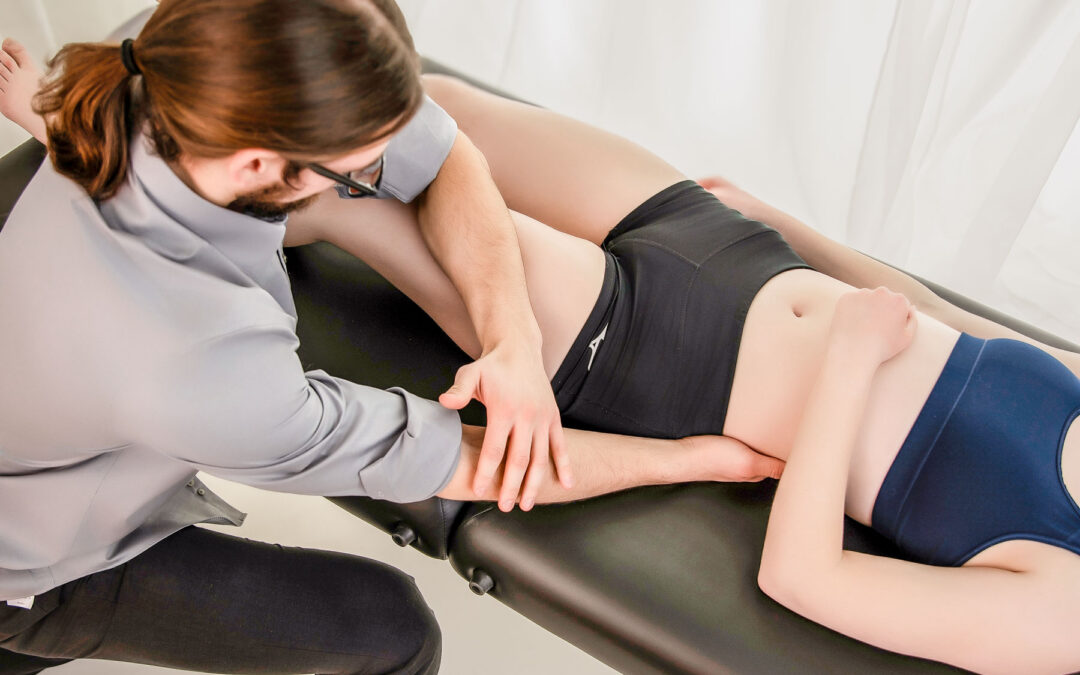
Equally important is how the myofascial work itself unfolds. Within a Structural Integration series, practitioners layer the work strategically, starting superficially to open space, and only then moving into the deeper structures that need to release.
This sequence matters: without first creating space at the surface, a deep release has nowhere to go, and the pattern simply bounces back. Unlike approaches that only address surface-level symptoms, Structural Integration targets the chronic fascial pain cycle at its source, systematically unwinding the postural patterns that keep the body stuck.